If you asked a neighbor who’s been running a small business for years what stood out in 2025, they’d probably shrug, smile, and say something like: “A lot changed, a lot stayed messy, and some trends finally made sense.” That’s the spirit here. The year is almost over, so it’s a good moment to look back and see how some key numbers moved. Not because stats magically solve your problems, but because they help you catch patterns you might otherwise miss.
Small and medium-sized businesses held steady as the backbone of the economy. Some sectors slowed, others grew, but the general tone stayed cautiously optimistic. Below you’ll find the big themes that shaped the year – mobile habits, AI adoption, reviews, trust signals, local search, budgets, and the state of small businesses overall.
Think of this as a friendly walk-through of the data, with the useful bits pulled out and the noise filtered.
How small businesses held up this year
When you zoom out, the broader picture of 2025 shows SMBs remaining a massive force. Most owners felt hopeful about revenue, hiring kept moving, and the overall ecosystem didn’t stall.
If you look at the U.S. data, for example, small businesses still made up almost all (99.9%) of companies in the country, and they held onto about 62 million workers. Several analyses – like the U.S. Chamber’s tracking – suggested that roughly seven in ten owners expected their revenue to grow next year, and almost half were preparing to increase investment instead of tightening the belt.

Even job creation stayed resilient. The SBA pointed out that small business establishments posted a net increase of roughly 1.4 million jobs, which isn’t explosive growth but signals stability in a year with plenty of uncertainty.
If you squint at these numbers, you see a steady line: cautious optimism, incremental job creation, and a sense that “growth is possible if we stay sharp.” For many owners, that meant improving digital presence, modernizing operations, and cutting invisible inefficiencies.
The website and mobile traffic story
Most conversations with SMB owners end up touching websites. You can almost hear someone say: “I know I need a mobile-friendly site… I’ll get to it eventually.” But “eventually” is exactly what hurts them, because mobile traffic kept dominating in 2025.
When researchers broke down global web traffic this year, the range hovered around the mid-60% mark for mobile. Some reports placed global mobile traffic at about 64% of all visits, while U.S. numbers sat slightly lower but still above the halfway mark. That’s two out of three customers arriving through a phone.
Ecommerce kept drifting toward mobile, too. About 44% of U.S. retail e-commerce sales were expected to happen through mobile devices – meaning your customer might pick a product, compare shops, read reviews, and check out all while standing in line somewhere.
What this means for your site:
- If your web page loads slowly on a phone, you’re losing people.
- If your layout breaks on small screens, you’re losing people.
- If your site builder doesn’t auto-optimize for mobile (which, luckily, Yola does), you’re spending time on tasks that should be automated.
One tip for you: look at your own site on your phone as if you were a stranger. The rough parts usually jump out immediately.
Local search, reviews, and why trust became the new currency
Imagine someone in your neighborhood looking for a plumber, a haircut, a yoga studio, or a repair service. How do they choose? Most of the time, they search on their phone, read a couple of reviews, and make a decision in seconds.This year reinforced that behavior. Studies on local business research showed that a strong majority – often over 70% depending on the source – check online reviews when deciding whether to trust a local provider. Another analysis found that nearly all consumers read reviews at some point in their buying journey, and about nine out of ten say those reviews directly influence their final decision.
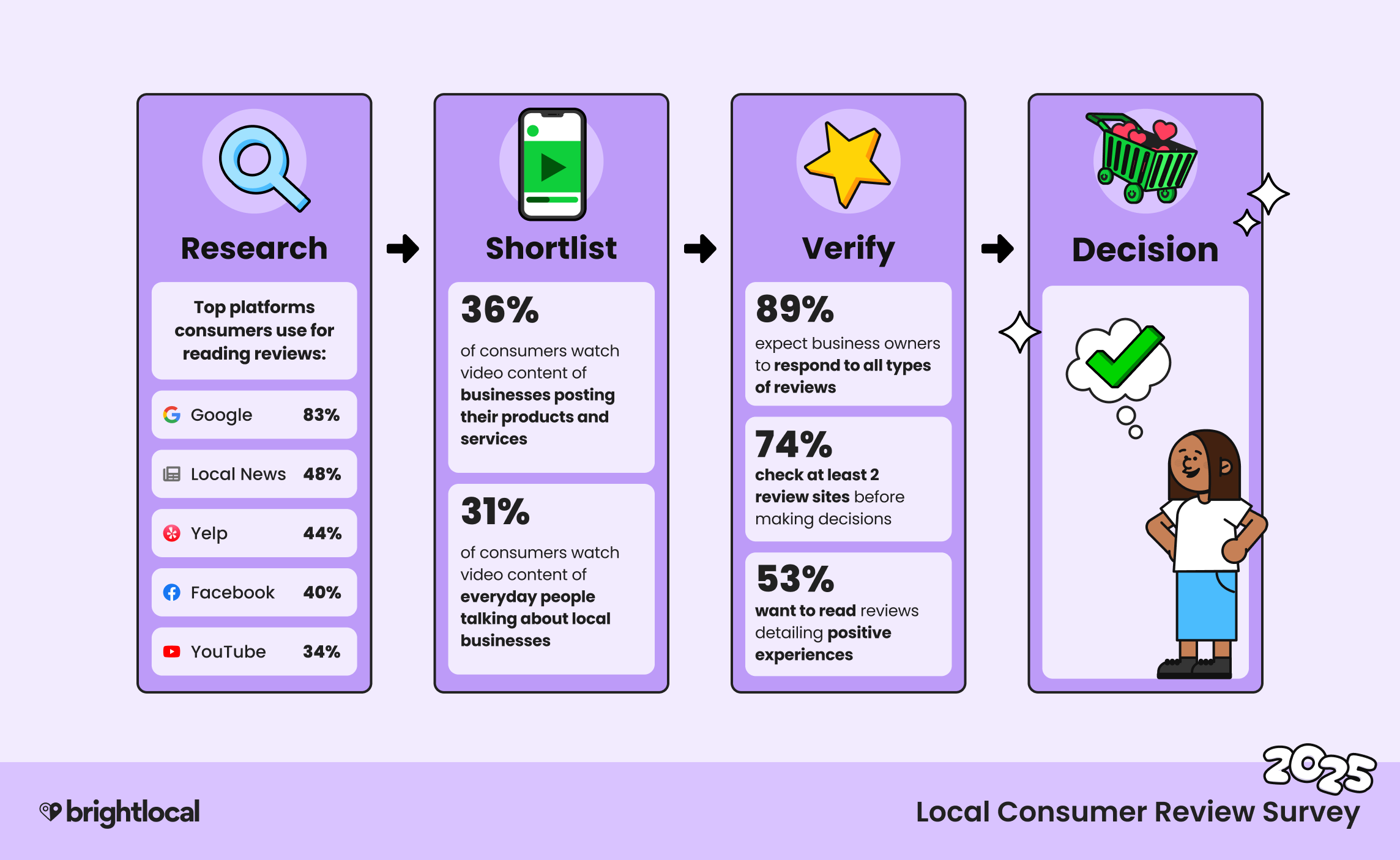
People also got more sensitive to rating changes. One study pointed out that moving from, say, a 3 stars to a 4 stars average rating could boost foot traffic by around 25%. That tiny improvement can come from something as simple as responding to feedback or inviting a few loyal customers to leave honest reviews.
A few patterns stand out:
- Google reviews dominate discovery.
- Responding to reviews (even negative ones) improves customer trust.
- Local search is tied to mobile behavior, not desktop behavior.
- Businesses that actively manage their reputation tend to grow faster than those that “set and forget.”
If you run a small business, the practical task list is short:
Claim your listings. Keep your info updated. Ask for reviews. Reply to them.
These habits cost almost nothing and build a moat over time.
AI went from “Maybe later” to “Let’s try it”
Last year, many small business owners treated AI like a novelty – interesting but maybe not relevant. This year, that shifted. More owners experimented with it, even if just in small ways.

Different surveys reported slightly different adoption rates, but the story stayed consistent: roughly half of SMBs were exploring AI in some form, and somewhere between a quarter and a third were actually integrating it into daily work. The most common uses were practical things – content creation, simple data analysis, customer messaging, and scheduling.
Another interesting detail: in one survey, 82% of SMBs that used AI also ended up hiring more people. This flips the usual fear that AI eliminates jobs. In small businesses, AI tends to remove boring tasks rather than people.
Owners using AI leaned on it to:
- Write content or product descriptions
- Build or translate pages
- Create design variations
- Analyse sales or traffic patterns
- Automate replies or basic customer communication
And here’s where Yola’s AI features naturally fit. Anything that speeds up website creation, translation, or design work lowers the barrier for SMBs that don’t have marketing teams. It’s not magic, but it does save time.
Budgets, spending, and the reality check
When you look at what small business owners actually spent money on in 2025, you don’t see a story of big splurges or dramatic cutbacks. It’s more like watching someone adjust the thermostat a degree at a time – small changes that add up but never feel flashy.
Most owners in the U.S. still work within modest margins. Median income sits around the mid-$60,000s according to recent analyses, which means every dollar has a job. But here’s the interesting twist: despite tight budgets, owners weren’t pulling back from technology. In fact, the opposite showed up in the biggest studies of the year.
The U.S. Chamber of Commerce’s 2025 Empowering Small Business report noted that around 8 in 10 SMBs planned to grow their tech adoption over the next few years, and many were already experimenting with digital tools to work faster and reduce manual tasks. That doesn’t automatically mean owners were increasing marketing spend, but it does hint at a mindset shift – technology isn’t optional overhead anymore. It’s a survival tool.
Another data point comes from Vistage’s mid-2025 small business survey, which found that 35% of SMB leaders expected to increase their fixed investments over the next 12 months. “Fixed investment” covers long-term assets like equipment upgrades, renovations, or durable tech systems. Not ads or subscriptions – actual infrastructure. Only 16% planned to reduce these investments, which tells you owners were still betting on themselves, even in an uncertain year.
So how does this translate into everyday decision-making?
Most businesses were tightening some areas while opening up others. A common pattern:
- trimming non-essential expenses
- delaying nice-to-have upgrades
- shifting dollars into digital tools that save time or increase visibility
- upgrading equipment only when it directly improved efficiency or customer experience
And if you listen to owners talk about why they invested, the logic is simple:
“If it helps customers find us, trust us, or work with us faster, it’s worth the money.”
That’s where websites, mobile optimization, review management, and even AI tools land. They’re not luxury expenses anymore – they’re part of staying competitive.
Where the trends point
If you were chatting with someone at a café about next year, a few predictions would come up naturally.
Here’s what the data quietly suggests:
- Mobile traffic probably won’t stop dominating.
- AI adoption will grow, but only businesses that integrate it into real workflows will benefit.
- Local search will keep deciding winners and losers in service categories.
- Review management will become as important as having a homepage.
- Marketing budgets will shift toward measurable digital activities.
The broad picture: customer expectations keep rising, even for tiny businesses. People want fast sites, quick answers, current info, clear trust signals, and good reviews.
Reading between the lines
Stats are interesting, but they never tell the whole story. Some apply to your business, some don’t, and a few may even contradict what you see in your day-to-day work. But they help you catch patterns you might otherwise miss. They’ve helped many owners rethink how they present themselves online, how they talk to customers, and how they use tools – AI or otherwise – to work smarter.
If there’s one takeaway from 2025, it’s this:
Don’t let the tech world move faster than your business.
Stay curious, check what your customers actually do, and adjust where it makes sense. Trends won’t run your business for you, but they can nudge you toward the next good decision.