Build your pet-focused business online and attract more clients! Our 10-step guide will help you create a professional website that highlights your services, inspires trust, and makes booking easy for pet owners.
Why pet care providers need to build a website
From dog walkers to grooming salons, from veterinary assistants to pet sitters, pet care professionals rely on trust and convenience. A website serves as your digital storefront, open 24/7, where potential clients can:
- See the services you offer (nail trimming, training, boarding, walking, etc.)
- Check your prices and packages
- Book appointments or order products online
- Read testimonials from other pet parents
- Get directions or contact you instantly
Without a website, animal care providers risk being invisible to prospects who search online for “pet sitter near me” or “dog grooming in [City].”
The challenge? Many pet service providers hesitate because they believe building a website requires technical skills, a large budget, or a significant amount of time. The reality is that with the right platform, creating a pet business website can be straightforward, affordable, and effective.
A step-by-step guide on building your animal-focused website
So, you already know why a website is crucial: people search online first when they need a groomer, trainer, or even pet first aid advice. A well-designed website makes it easy for visitors to find what they’re looking for and helps you market your pet site to the right audience and gain their trust and credibility. Beyond showcasing services, your website can drive traffic to your website through features such as Google My Business integration and smart search optimization.
This step-by-step guide will show you how to create a professional online presence that feels simple to manage and helps your pet business grow. Let’s dive in!
1. Define your website goal
Every animal care business has different priorities. Before you start building, decide what role your website should play. A clear purpose helps you design a site that works for you, not just looks nice.
Common goals for pet care websites
- Booking management: If you’re a groomer, trainer, or dog walker, your site should make it easy for clients to schedule services online. An integrated booking form or calendar can save you hours of phone calls.
- Building trust: Your prospects want reassurance that their furry friends are in safe hands. A website focused on credibility should emphasize your certifications, years of experience, insurance, and testimonials from happy clients.
- Local visibility: For mobile pet sitters or neighborhood animal care specialists, the primary goal may be to appear in search results in your area. In that case, your website needs strong location-specific keywords and clear service area details.
- E-commerce: If you sell products like treats, grooming kits, or accessories, your goal could be driving sales. In that case, your homepage should highlight your online store, bestsellers, and promotions.
- Education and engagement: Some animal care providers use their websites to share useful tips and guides, which helps build authority and keeps clients coming back.
Questions to guide your goal of starting a website
- What specific actions do you want your target audience to take? (Book, call, buy, subscribe)
- How will you measure success? (Number of bookings, sales, or new inquiries)
- What do you want visitors to remember most about your business?
A website with no goal is like a pet care business without a schedule – chaotic and stressful. With a clear objective, your site becomes a reliable tool that supports your daily work.
To make this process easier, the Yola AI Website Builder can generate draft pages tailored to your pet care goals. Just enter a few details about your business, and it will create a personalized starting point, whether you want to focus on bookings, product sales, or building loyalty and trust.
2. Choose a pet care website builder that works for you
The right website builder should match your skills, time, and business needs. Not every pet care provider has the same priorities. Some want speed, others want control, and many simply want to avoid the frustration of complicated tech.
What to look for in a builder
- Ease of use: A WYSIWYG (What You See Is What You Get) editor is more intuitive than drag-and-drop tools. With Yola, what you edit on the page looks exactly like what your visitors will see, no surprises, no guesswork.
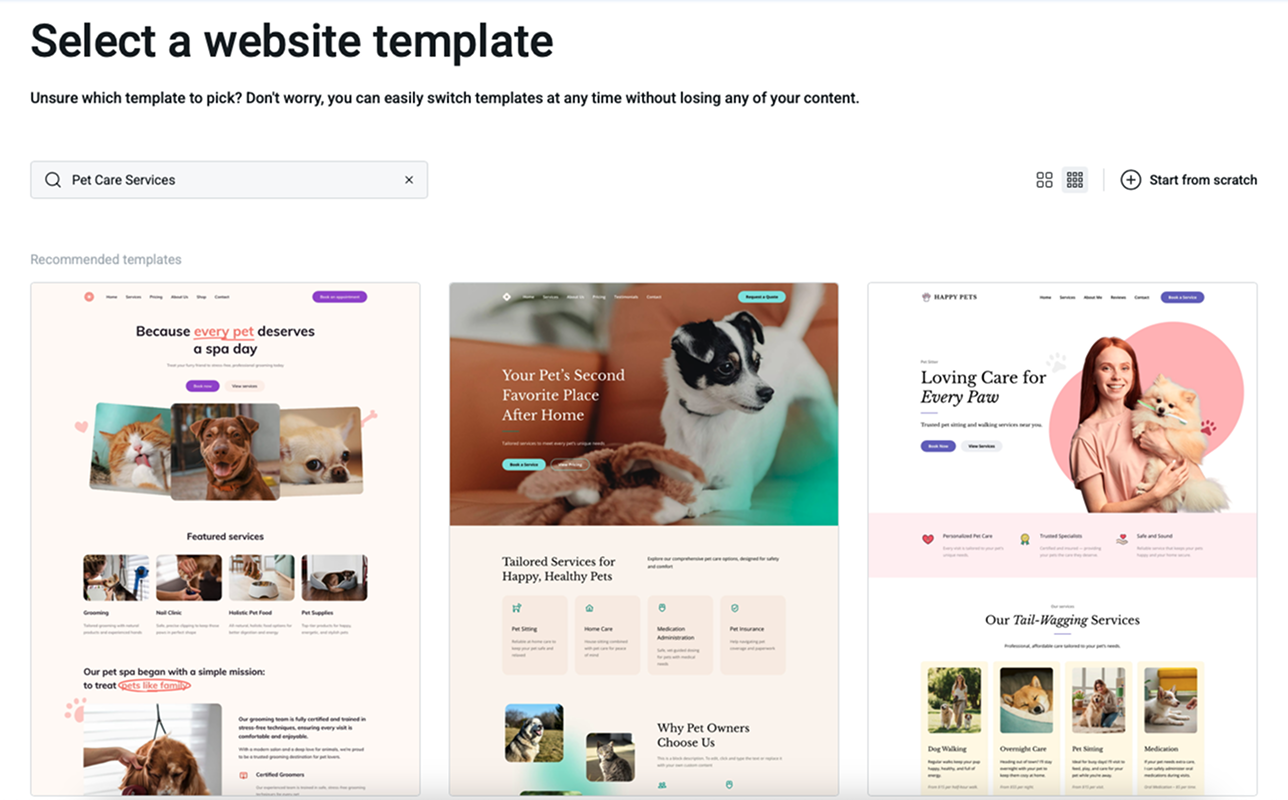
- Professional templates: As a pet care provider, you don’t need to start from a blank page. Yola offers a fresh pack of pet service–related templates designed for trainers, walkers, sitters, and boarding services. Each template is ready to customize with your colors, images, and text.
- Built-in store option: If you sell pet supplies like leashes, treats, shampoos, toys, you’ll need e-commerce functionality. Yola’s online store integrates smoothly into your site so you can manage products, payments, and shipping in one place.
- Domain options: A professional web address makes you look trustworthy. Yola offers domains directly within the platform (we’re resellers, so you can register and manage your domain with us while we handle the behind-the-scenes setup).
- Scalability: Start small and grow as you need. Whether you begin with a one-page site or expand to include an online store, blog, or booking system, your builder should support the growth of your business without forcing you to rebuild from scratch.
Why Yola fits pet care businesses
Many pet care professionals juggle long days of appointments, travel, and client communication. Time is precious. Yola was built for people who want a professional website without having to learn coding or spend weeks figuring things out.
With the Yola AI Website Builder, you can go from idea to working draft in minutes. Just answer a few questions about your business (dog walking or pet sitting) and the AI generates tailored text and design blocks that you can polish to fit your brand.
3. Pick a domain name for your pet business website
Your domain name is your online address and the first thing your prospect will see and remember. A strong domain builds trust, makes you easier to find, and shows you take your business seriously.
Tips for choosing the right domain
- Keep it short and clear: Long or complex names are harder to type and easier to forget. Aim for something simple like HappyPawsBarcelona.com instead of TheBestPetGroomingAndBoardingServicesInTown.com.
- Make it relevant: Include words related to your service or location so people know instantly what you do. For example, SunnyvaleDogWalking.com tells both your audience and search engines exactly what to expect.
- Avoid tricky spellings: Fancy or unusual spellings might look creative, but they can confuse visitors trying to type your site in a hurry. Stick to easy, intuitive wording.
- Check availability on social platforms: Ideally, your domain matches or aligns with your business name on Instagram, Facebook, or TikTok so clients can find you consistently across channels.
- Think long-term: Pick a name that will still work if your services expand. If you start as SallysDogWalking.combut later add training or boarding, you might outgrow it. Something broader, like SallysPetCare.com gives more flexibility.
Securing your domain
With Yola, you can search for and register your domain directly inside the builder. We handle the setup, so your website and domain connect seamlessly, with no extra steps or technical headaches.
4. Leverage AI tools to save time
Running a pet care business means juggling many roles like caregiver, scheduler, marketer, and sometimes even photographer. Your time is limited, and repetitive website tasks can eat into the hours you’d rather spend with pets or clients. That’s where AI tools can step in.
How AI helps pet care businesses
- Content creation: Struggling to write service descriptions or a welcoming homepage intro? AI can generate polished drafts that you can adjust to your voice. For example, instead of staring at a blank page, you get ready-to-edit text about your service packages or dog-walking routes.
- Design support: Picking layouts, colors, and images can feel overwhelming. AI assistants can suggest design combinations that look professional and fit the pet care industry, saving you from endless trial and error.
- Efficiency in updates: Need to add a new service or announce a promotion? AI can quickly generate matching copy or blocks that blend seamlessly with your existing site.
Yola’s AI assistants at work
Yola has built AI into its platform to make website building faster and less stressful:
- AI Website Builder: Creates a tailored draft site in minutes based on your pet care niche, dog walking, boarding, or training.
- AI Design Assistant: Suggests layouts, colors, and template customizations so your site feels unique without you needing a design background.
- AI Block Assistant: Helps you generate specific sections like a pricing block, FAQ, or about us without having to build from scratch.
- AI Text Assistant: Writes or rewrites content for your pages, blog posts, or product descriptions, saving you hours of typing.
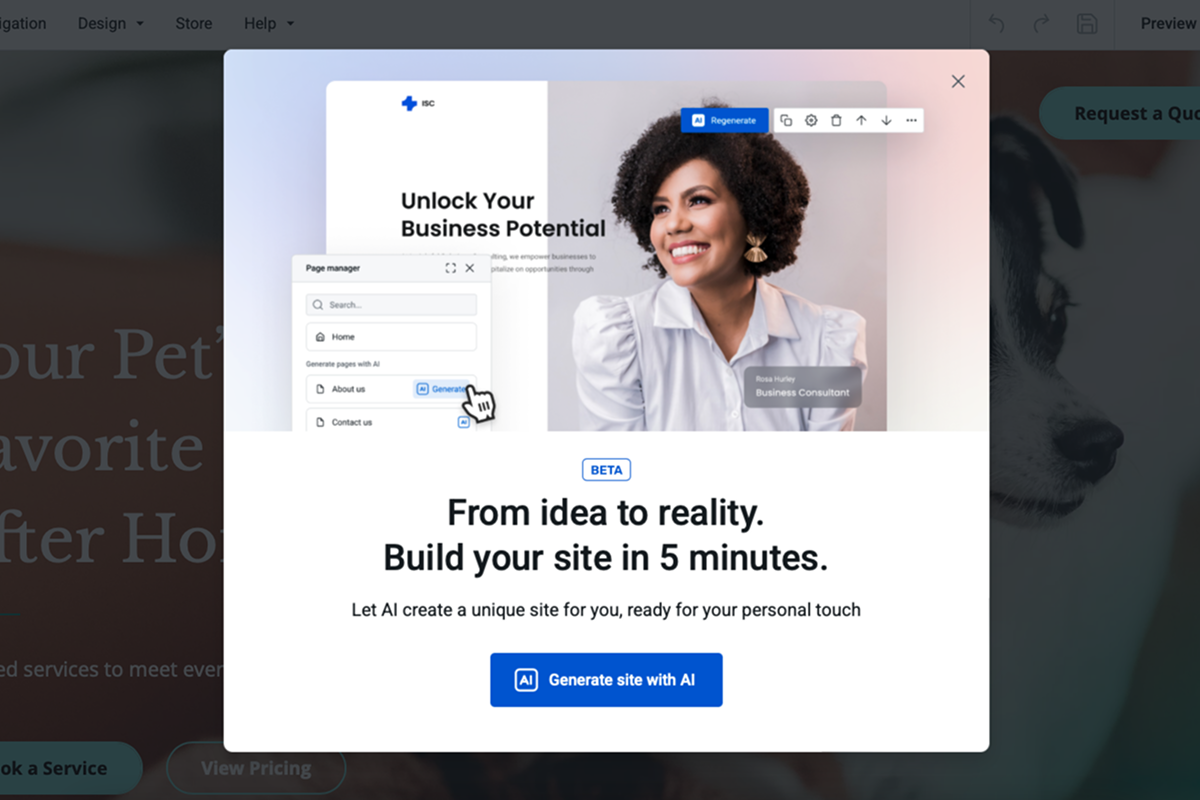
With these tools, you don’t just build a website – you build it faster, with less friction, and with professional polish from the start. For pet care providers, this means less time battling tech and more time focusing on what really matters: happy clients and healthy pets.
5. Add calls to action (CTAs) and contact info
A website without clear actions leaves visitors wondering what to do next. Visitors need guidance, whether it’s booking a grooming appointment, calling for a walking schedule, or browsing your pet supplies. Strong CTAs and easy-to-find contact details turn casual visitors into paying clients.
What makes an effective CTA
- Be specific: Instead of vague “Learn more,” use direct prompts like “Book a grooming session” or “Schedule a free meet & greet.” People are more likely to act when they know exactly what to expect.
- Keep it visible: Place CTAs at natural decision points—on your homepage, service descriptions, and even blog posts. Don’t hide them at the very bottom of the page.
- Use action words: “Call now,” “Shop treats,” or “Check availability.” They give a sense of immediacy and encourage action.
- Limit distractions: Each page should focus on one or two key actions. Too many buttons can overwhelm visitors.
Contact info that builds trust
Pet owners want to know they can reach you easily, especially if they’re trusting you with their animals. Include multiple, clear options:
- Phone number: Ideal for urgent inquiries like last-minute boarding.
- Email or contact form: For detailed questions or booking requests.
- Physical location (if applicable): Helpful for groomers, trainers, or stores with walk-in customers.
- Social media links: Many parents like to follow providers on Instagram or Facebook to see photos, updates, or reviews.
6. Showcase client testimonials
When animal owners look for a new walker or sitter, they’re not just buying a service – they’re trusting you with a family member. Testimonials are one of the strongest tools to build that trust. Hearing from other happy clients reassures new visitors that their pets will be safe, cared for, and loved.
Why testimonials matter in pet care
- Emotional reassurance: A review like “Bella came home happy and relaxed after her grooming” does more than describe a service—it eases worries.
- Social proof: Seeing that other pet owners already trust you lowers the barrier for new clients to reach out.
- Local credibility: Testimonials from people in the same neighborhood or city carry extra weight, especially when paired with photos of their pets.
- Highlighting strengths: Feedback often mentions details you might overlook—punctuality, patience with anxious pets, flexibility with scheduling—that make your service stand out.
How to collect testimonials
Gathering testimonials doesn’t have to feel forced or complicated, it works best when it feels like a natural part of your relationship with clients. One of the easiest moments to ask is right after a positive interaction. For example, if a dog comes home freshly brushed, nails trimmed, and the owner is thrilled, that’s the perfect time to invite them to share a few words about their experience. Similarly, after a first successful walk with a nervous pet, many owners are eager to express their relief and gratitude.
You can also make it easy for clients to leave feedback by providing a simple form directly on your website. A short, friendly prompt such as “Tell us how we did and share your pet’s story” encourages responses without making people feel like they need to write something formal. Beyond your site, reviews collected on platforms such as Google or Facebook can be repurposed – just ask for permission before featuring them on your page.
Adding a visual element, like a photo of the pet alongside the testimonial, makes the story more memorable and real. Many pet parents love showing off their animals, so pairing their words with an image of a happy cat or a dog creates a powerful piece of social proof.
Best practices for displaying testimonials
- Keep them short and authentic: A few sentences often feel more genuine than long paragraphs.
- Spread them across the site: Place a testimonial on the homepage, service pages, and even near booking CTAs.
- Make them scannable: Highlight key words in bold or use pull quotes so visitors catch the message quickly.
7. Highlight your services (and store, if relevant)
Your website should clearly explain what you offer so that visitors instantly understand how you can help them and their pets. Many visitors arrive on your site with a specific need in mind – maybe they’re looking for a reliable dog walker, a cat sitter for the weekend, or a trusted groomer. If those services aren’t front and center, you risk losing their attention. A dedicated Services page helps you organize this information in a way that’s both detailed and easy to scan. For example, you might outline packages like daily dog walks, overnight sitting, or pet styling options, including pricing and what’s included.
Clarity matters just as much as completeness. Instead of listing “boarding,” describe it in a way that speaks to what the pet owner cares about, such as “Safe, stress-free overnight stays with plenty of playtime and updates.” The more specific and reassuring your descriptions, the more likely people are to trust you.
If your business also sells pet-related products, an online store becomes an extension of your services. With Yola, you can add a fully integrated store where customers browse and purchase items like leashes, grooming tools, or healthy treats. This way, clients who book a grooming appointment might also pick up a brush you recommend, or someone using your walking services could easily order harnesses right from your site.

It helps to connect your store and services naturally. For instance, if you offer grooming, showcase shampoos or brushes in the same section. If you provide training, highlight treat pouches or clickers. These subtle connections make your website more useful to prospects and create opportunities for repeat business.
8. Optimize for local search
Most pet care services depend on local clients. You’re not trying to attract pet owners across the country, but those in your neighborhood who need help walking their dog, boarding their cat, or scheduling a last-minute grooming. That’s why optimizing your website for search engines is one of the most effective ways to attract the right visitors.
The first step is to use location-based keywords throughout your website. Instead of saying “professional dog walking,” say “professional dog walking in [Your City]” or “trusted pet sitter near [Your Neighborhood].” Including your city, district, or even local landmarks in your text tells search engines and prospects that you serve a specific area.
Creating dedicated pages for each service area can be especially powerful if you operate across different neighborhoods. For example, you might have one page about “Dog walking in Downtown Barcelona” and another for “Pet sitting in Poble Nou.” Each page can include tailored details, such as testimonials from clients in that area, or a quick mention of nearby parks where you walk dogs.
Another important piece of local SEO is visibility beyond your own website. Make sure your business is listed consistently across online directories like Google Business Profile, Yelp, or Facebook. Include your exact business name, address, and phone number on each listing to help search engines verify your legitimacy. Adding a Google Map to your website can also reassure potential clients—they’ll know you’re truly local and can find you at a glance.
Encouraging reviews on platforms like Google or Facebook also plays a big role in boosting your search ranking. A simple follow-up message after a successful service, thanking the client and asking for a review, can gradually build a strong reputation online. Those reviews are not only helpful for SEO but also they’re often the first thing new clients read before making a booking.
With Yola’s built-in SEO tools, you don’t need to be an expert to make these adjustments. You can set page titles, add meta descriptions, and customize URLs so they’re clear, descriptive, and optimized for location-based searches, all from the editor. This helps ensure your website not only looks professional but also performs well in search engines, bringing in more nearby clients who are actively looking for your services.
9. Test and backup your website
Once your animal care website is live, it’s tempting to think the work is done. But just like pet styling or training, a website needs regular checkups to keep running smoothly. Testing ensures visitors have a seamless experience, and backups protect all the work you’ve put in from being lost unexpectedly.
Start by browsing your site as if you were a potential client. Can you easily find the dog walking service page? Does the booking form submit without errors? Are the store checkout steps clear? Small issues like a broken link, a missing phone number, or a slow-loading gallery of pets can frustrate users and cause them to leave before booking. Periodic testing on both desktop and mobile devices helps catch these problems before your clients do.
Performance testing is just as important. A page that takes too long to load can mean the difference between someone scheduling a grooming appointment and someone bouncing to a competitor’s site. Tools like GTmetrix or Google PageSpeed Insights show you where your site might need improvements, such as compressing large images or simplifying page structure.

Alongside testing, maintaining regular backups is a safeguard you can’t afford to skip. Websites can break due to accidental changes, plugin conflicts, or even security threats. With Yola, backups happen automatically under certain conditions, such as when you save or publish your site, and you can also create manual backups when making big changes. That means if something goes wrong, you can restore your website to an earlier version in just a few clicks.
Think of backups as the digital equivalent of having a spare leash – you hope you won’t need it, but it’s essential when something unexpected happens. Testing keeps your website reliable for pet owners who depend on you, while backups protect your investment of time, effort, and credibility. Together, they ensure your website stays a stable, trustworthy hub for your services.
10. Keep your content fresh
A pet-focused website isn’t meant to be static, it should feel alive and active, much like the pets you care for. Fresh content shows visitors that your business is engaged, attentive, and up to date. It also gives search engines more reasons to recommend your site, which can help bring in new local clients.
Think about your website as an ongoing conversation with pet owners. If someone visits once and sees the same unchanged information months later, they might assume your services are outdated, too. But when they see recent posts, updated photos, and timely advice, they’re reassured that you’re still actively caring for pets and available to help them.
Here are a few ways to keep your site current:
- Update service details whenever you add something new, like puppy training, holiday boarding, or extended walking hours.
- Refresh your photo galleries with images of pets you’ve cared for (with owner permission). A happy dog after grooming or a relaxed cat after boarding tells a compelling story.
- Highlight promotions or events, like discounts for first-time clients, adoption day partnerships, or charity walks.
- Rotate testimonials so new visitors see different client stories over time.
- Share news about your business, whether you’ve moved to a bigger facility, hired a new team member, or launched an online store.
Even small updates like changing a homepage photo or adding a quick tip of the month signal activity. And with Yola’s editor, these updates take minutes, not hours. You can even do it from your mobile on the go. Regular maintenance keeps your site useful, trustworthy, and visible, ensuring pet owners come back again and again.
Bring your pet care business online with confidence
Your website is more than a digital brochure – it’s the place where pet owners decide whether they can trust you with their furry family members. By defining your goals, showcasing your services, collecting authentic testimonials, and keeping your content fresh, you create a space that feels both professional and personal. Add in local search optimization and strong calls to action, and your site becomes a powerful tool for attracting and retaining clients in your community.
With Yola website builder, AI assistants, and new pet service templates, building that site doesn’t require coding or design skills. You can focus on what matters most – caring for pets – while your website works in the background to bring in new bookings, product sales, and lasting customer relationships.
Even if your passion for animals drives your business, first impressions often come from your company website. If you need a website that reflects your care and professionalism, website design and website performance should be at the top of your priorities. A well-built company website shows you value quality, reassures clients from the start, and gives your pet care services the visibility they deserve.Your next client could be searching right now. Make sure they find you, trust you, and book with you.